




Port Canaveral and Galveston Are Getting Bigger — Here's What That Means for Your Next Cruise
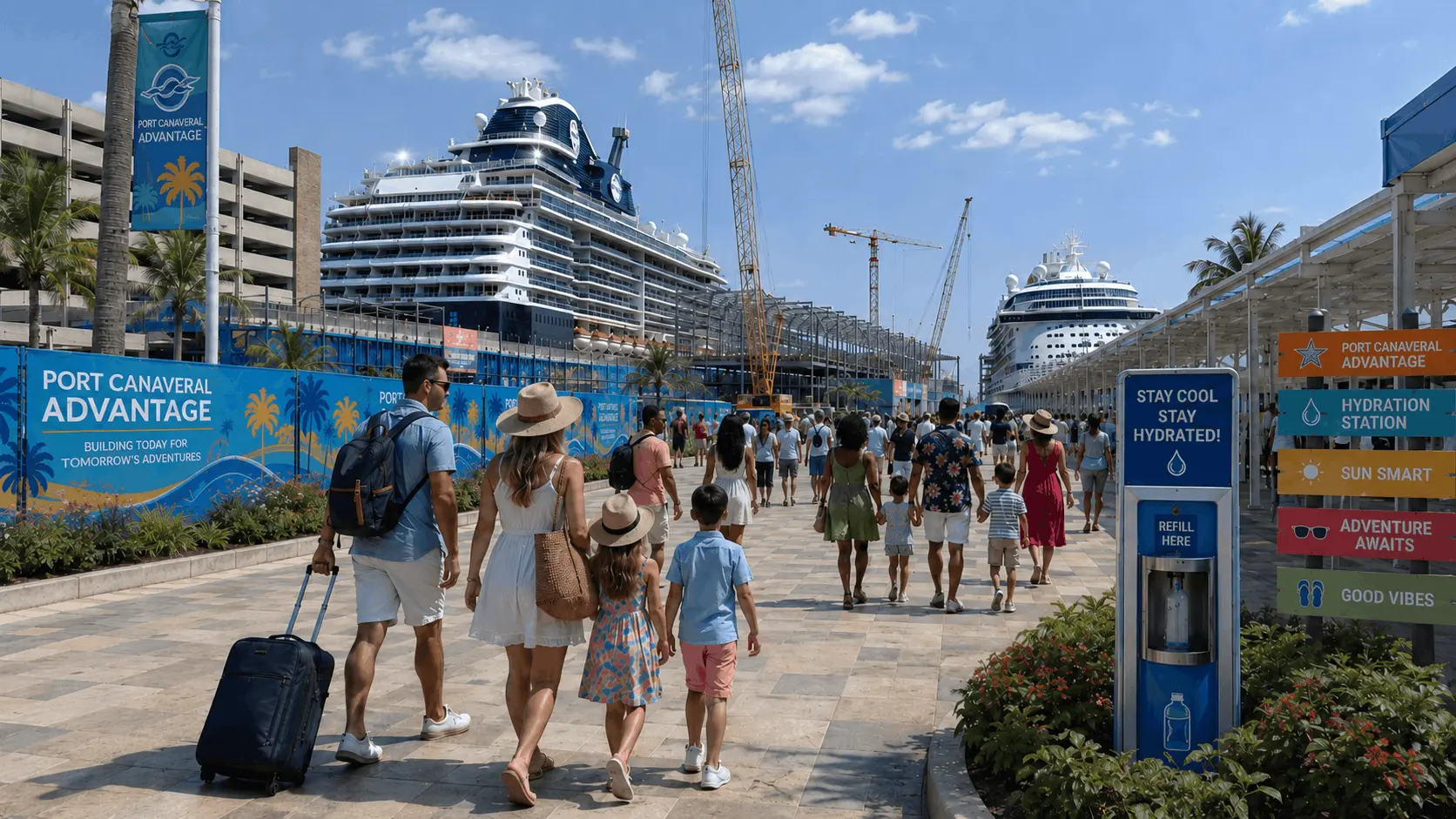


Port Canaveral and Galveston Are Getting Bigger — Here's What That Means for Your Next Cruise
Two of America's busiest cruise homeports are spending billions to welcome larger ships and millions more passengers. The payoff for cruisers: more sailings, more itineraries, and more competition for your booking.
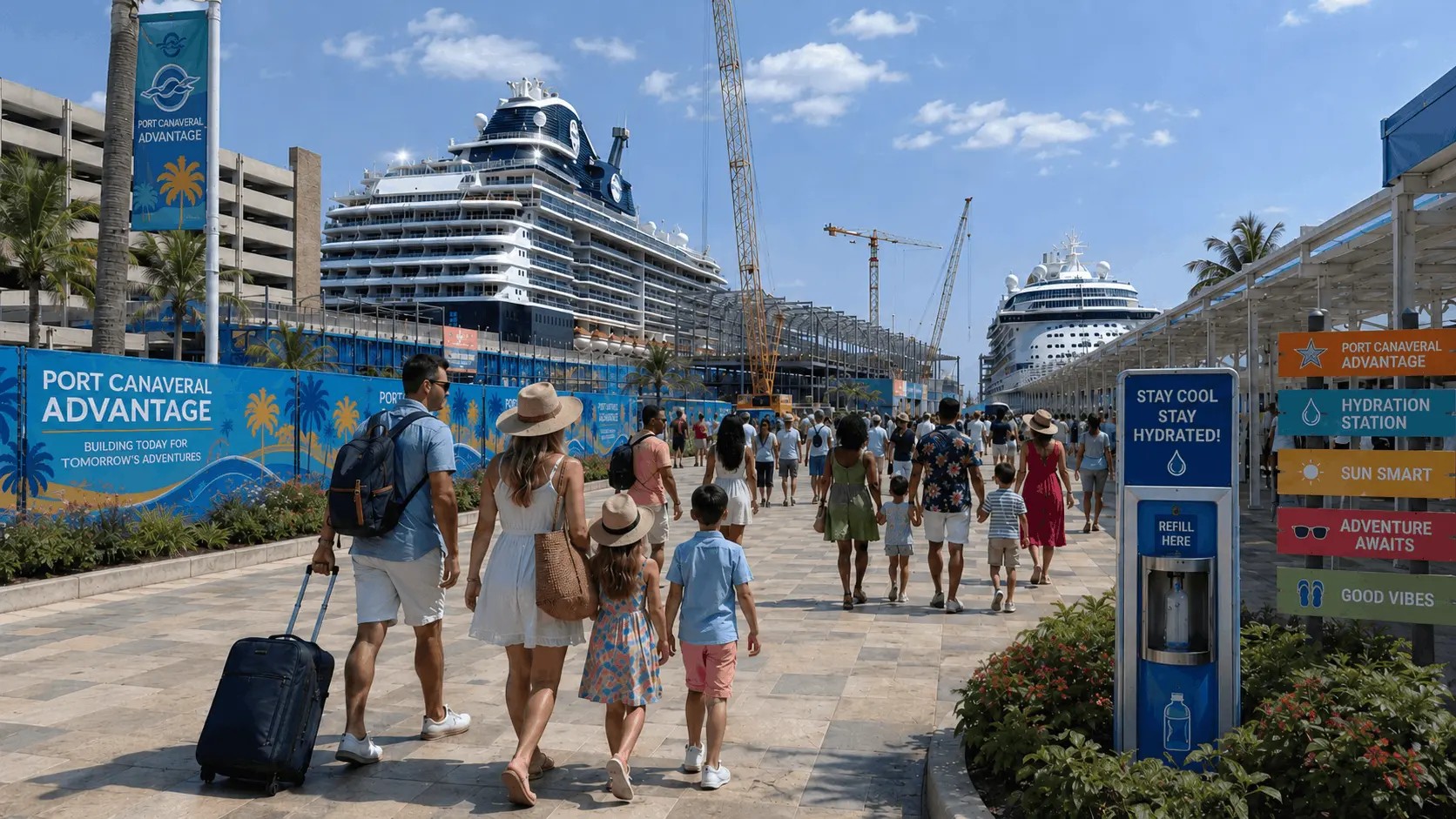
Port Canaveral Renovations Concept Based on Updated Available Knowledge (Rendering)
Port Canaveral just became the busiest cruise port on the planet. Galveston approved a $2.4 billion plan to nearly triple its terminal capacity over twenty years. Both ports are building for ships that do not exist yet — and both are reshaping what it means to cruise from the American South.
What makes this worth paying attention to is not the construction itself. It is what happens after the concrete dries. More terminal space means cruise lines can station more ships — and bigger ships — at these ports year-round. More ships mean more sailings on the calendar. And more sailings, if history is any guide, mean better pricing and wider itinerary choices for the people who actually book them.
Here is what each port is building, who benefits, and what to know if you sail from either one in the next few years.
What cruisers want to know first
Port Canaveral and Galveston are both mid-expansion. Here are the answers to the questions readers ask most before we dig into the details.
Q1How much is being invested in Port Canaveral and Galveston cruise expansions?
Port Canaveral is spending roughly $1 billion on infrastructure upgrades, while Galveston has approved a 20-year master plan valued at $2.4 billion.
Q2Is Port Canaveral really the busiest cruise port in the world?
Yes. In fiscal year 2025, Port Canaveral recorded over 8.6 million revenue passenger movements, surpassing PortMiami.
That figure represents a 13 percent increase over the previous year.
Q3Will these expansions mean cheaper cruise fares?
More berths and terminals invite more ships, which increases cabin supply and competition among cruise lines — factors that tend to put downward pressure on pricing.
Q4How many ships will Galveston be able to handle after expansion?
The master plan envisions capacity for up to seven cruise ships at once, with up to three new terminals planned.
Q5Should I expect embarkation-day disruptions if I sail during construction?
Possibly. Active construction can affect terminal access, parking, and traffic flow, so checking your cruise line's latest embarkation instructions before departure day is important.
Q6When will Port Canaveral's Terminal 5 expansion be finished?
The expanded terminal and its parking garage are expected to be operational within the next couple of years, with broader port-wide upgrades following on a longer timeline.
Port Canaveral: How a Florida Port Became the Busiest on Earth
The numbers arrived quietly. In fiscal year 2025, Port Canaveral recorded over 8.6 million revenue passenger movements — a 13 percent jump from the previous year — surpassing PortMiami to claim the top spot globally, according to the Canaveral Port Authority. The port also crossed its 100-million-passenger milestone for all-time traffic, a marker that took decades of steady growth to reach.
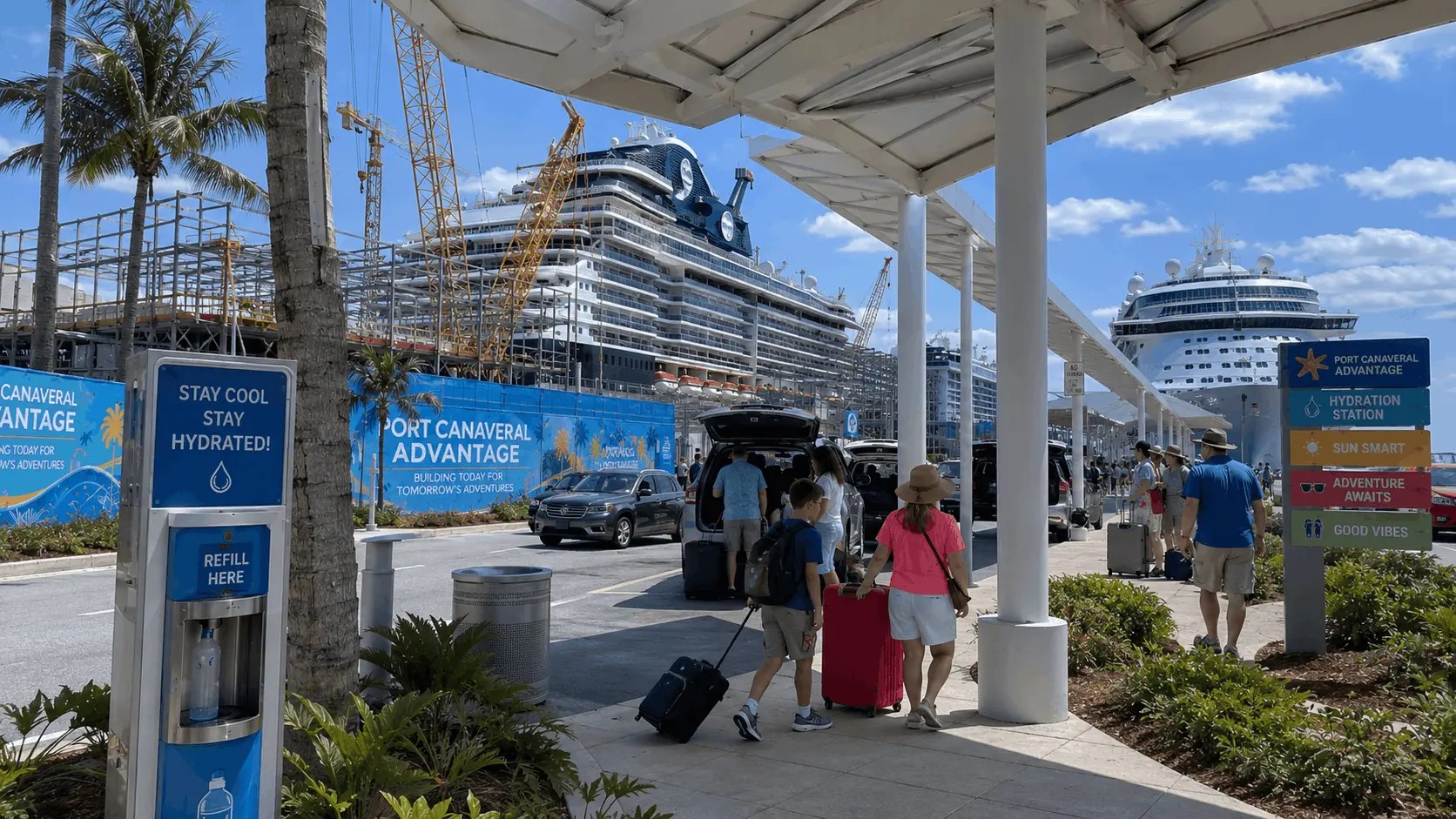
Seven terminals. Eighteen homeported ships. Seven cruise line brands operating simultaneously. Port officials project $200 million in cruise revenue for 2026, making the cruise business one of the most significant economic engines on Florida's Space Coast.
The port's appeal to cruise lines — and to travellers — is practical. It sits closer to Orlando and Central Florida's theme parks than any other major homeport. Parking is plentiful and adjacent. The terminals are modern. For families combining a cruise with a theme park visit, the geography alone makes it the obvious departure point.
The Terminal 5 Expansion: Built for Ships That Haven't Launched Yet
The centrepiece of Port Canaveral's current investment is the expansion of Cruise Terminal 5. The project will nearly double the terminal's footprint from 90,000 square feet to 170,000 — large enough to process passengers for the cruise industry's newest mega-ships, the kind that carry 6,000 to 9,000 guests and need shore-side facilities built to match.
Alongside the terminal, a 13-storey parking garage with 3,700 spaces is going up. That may not stir the imagination, but anyone who has circled a port parking lot at 10 a.m. on embarkation day knows exactly how much this matters. Together, the terminal and garage carry a price tag of $175 million.
These projects sit inside a broader $1 billion infrastructure plan. The signal is clear: Port Canaveral is not just accommodating the ships that exist today. It is building for the vessels currently taking shape in European shipyards — ships so large that only a handful of ports worldwide will be able to turn them around on a seven-day cycle.
Galveston: The Gulf Coast Port That Keeps Outpacing Projections
Galveston's growth story has been fast enough to surprise even its own planners. The port is now the fourth-busiest cruise homeport in the United States, moving roughly 3.6 million passengers annually. In the first four months of 2025, more than 650,000 cruise passengers sailed from Galveston — a 7.6 percent increase over the same period the year before, according to Houston First.
Port officials are preparing for a record 3.9 million cruise passengers in 2026. That growth is fed partly by national momentum — AAA projects that 21.7 million Americans will cruise this year, up from 20.7 million in 2025 — but it also reflects what Galveston has already built. A fourth cruise terminal opened in late 2025. A $53 million renovation and expansion of Cruise Terminal 25 added significant capacity. Capital investments totalling $334 million have effectively doubled the number of cruise terminals the port operated just a few years ago.
Four major cruise line brands now homeport ships in Galveston, giving Gulf Coast travellers access to a range of ships and itineraries without leaving Texas.
Galveston's $2.4 Billion Vision: Seven Ships at Once
In March 2026, the Galveston Wharves Board approved a 20-year strategic master plan with a $2.4 billion price tag. The scope is hard to overstate. The plan calls for up to three new cruise terminals, on-site parking garages, hotels, retail, and a pedestrian greenbelt that would reshape the island's waterfront into something closer to a full cruise district.
The target: seven ships docked simultaneously. That is a striking number for a port that was operating just two cruise terminals before the current wave of expansion began.
Research cited by port officials suggests Galveston could roughly double its passenger movements over the next decade, reaching between 7 and 8 million by 2036. By 2045, the port's cruise market capture is forecast to triple, with gross revenues climbing from roughly $87 million last year to a projected $344 million. Port Director Rodger Rees has described the progress with a line that captures the port's culture well: "I'm happy to report that we're working the plan, and the plan is working."
What This Actually Means If You Book Cruises
Port expansions are infrastructure stories, but their consequences show up in cabin availability, itinerary variety, and pricing. The mechanics are straightforward: when a port can handle more ships, cruise lines deploy more ships there. When more brands operate from the same homeport, they compete for your booking. Competition, historically, has been good for pricing.
For Gulf Coast cruisers, Galveston's expansion changes the calculation. More terminals and more brands operating simultaneously mean you can compare ships, itineraries, and prices across multiple lines without changing your departure city. Galveston already serves a strong drive-to market — Houston is an hour away, and the port draws from across Texas, Louisiana, and the broader Gulf region. Adding capacity makes it a genuine alternative to flying to Florida for many travellers who previously had limited options.
Port Canaveral's growth reinforces a different advantage. The proximity to Orlando's theme parks makes it a natural pairing for families building a cruise-and-parks vacation. The sheer volume of ships — eighteen homeported vessels across seven brands — means weekly sailings to the Caribbean and Bahamas on multiple lines, with enough variety in ship class and price point that most travellers can find something that fits.
Both ports are also likely to see itinerary expansion. When a cruise line commits a ship to a homeport, it builds a rotation of sailings around it. A bigger, more capable terminal opens the door to longer voyages, repositioning cruises, and seasonal itineraries — the kind of sailings that only make economic sense when the port infrastructure can support quick, high-volume turnarounds.
What to Know If You're Sailing During Construction
Building at an active cruise port introduces embarkation-day wrinkles that are worth preparing for. If you are sailing from Port Canaveral while the Terminal 5 expansion is underway, check your cruise line's terminal assignment and any updated parking directions before you arrive. The new 3,700-space parking garage will eventually simplify things, but the construction period itself may reroute traffic or shift drop-off locations.
Galveston's situation is similar. The master plan includes improved internal roads and updated traffic flow alongside terminal construction, but early phases of work can create bottlenecks on peak embarkation days. Arriving with an extra thirty to forty-five minutes of buffer is a simple hedge that costs nothing.
Both ports are strong drive-to markets, which means you control your own arrival time — an advantage over fly-to ports where flight delays can cascade into embarkation stress. Use it. Check the port's website or your cruise line's embarkation instructions a week before your sailing, not the night before.
Before you board
The Expansion Timelines Worth Watching
Port Canaveral's Terminal 5 project is already in progress, with the expanded terminal and parking garage expected to be operational within the next couple of years. The broader $1 billion infrastructure plan extends beyond that, but the near-term impact — larger ships homeporting, higher embarkation capacity — will be visible soon.
Galveston's phased plan stretches over two decades, with the most significant new terminal construction expected in the next five to ten years. The port has already demonstrated it can execute on ambitious timelines: the fourth terminal opened ahead of schedule in late 2025, and capital investments have consistently tracked the master plan's targets.
For travellers thinking further ahead, new terminals typically bring new ship deployments. New deployments often come with introductory pricing and fresh itineraries as cruise lines build demand for unfamiliar rotations. Watching these timelines is not just industry curiosity — it is a practical way to spot good deals before they are widely known.
Quick FAQ
Quick-reference answers drawn from the full article. For detailed breakdowns, see the sections above.
How many passengers does Port Canaveral handle annually?
How big will Galveston's expansion be?
Will more terminals actually lower cruise prices?
Should I worry about construction if I'm sailing soon?
When will Port Canaveral's Terminal 5 expansion be finished?
How large will the new Terminal 5 be?
 Blog guide
What You Can and Can't Bring onto a Cruise Ship
A complete guide to prohibited and allowed items on cruise ships, from alcohol and electronics to the fire-hazard items that…
 Blog guide
Is Southampton Really the Cruise Capital of Europe?
Southampton handles 3 million+ cruise passengers yearly from 45+ ships. Learn which cruise lines sail from here, what…
 Blog guide
Holland America Is Going Year-Round in Europe — Here's What That Actually Means for You
Holland America is keeping two ships in Europe year-round starting 2027. Here's what that means for itineraries, pricing,…
 Blog guide
Knicks Finals Tickets vs. a Summer Cruise: The Math Is Embarrassing
Knicks Finals tickets cost $3,700+ each. For the same money, a family of four can cruise to Bermuda from New York for a full…
 Blog guide
Cruises from New York to Bermuda: What to Know Before You Book
Everything you need to know about cruising from New York to Bermuda — itineraries, timing, costs, what to do on the island,…
 Blog guide
Royal Caribbean's Discovery Class: What We Know, What We Don't, and What It Means for Your Next Cruise
Royal Caribbean's Discovery Class ships arrive in 2029. Here's what is confirmed, what is still unknown, and who these new…
Ready to explore your options?
Schedules and availability may shift as terminal construction progresses. A cruise advisor can help you stay current.