
Royal Caribbean's Discovery Class: What We Know, What We Don't, and What It Means for Your Next Cruise

Royal Caribbean's Discovery Class: What We Know, What We Don't, and What It Means for Your Next Cruise
Two new ships, a new shipyard partnership, and a deliberate step away from the mega-ship era — here is where things stand.
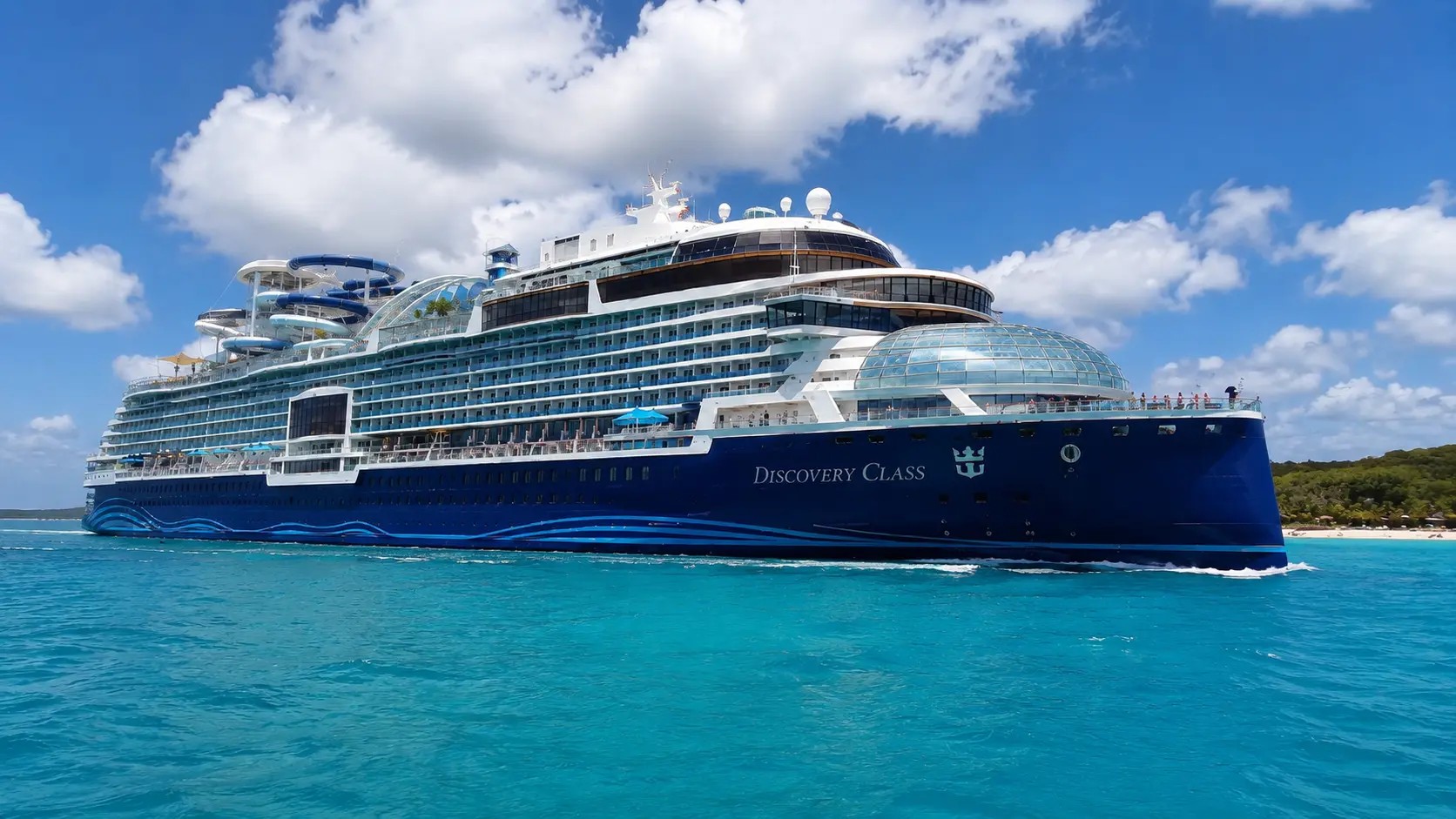
Royal Caribbean Discovery Class Concept Based on Updated Available Knowledge (Rendering)
Royal Caribbean has spent the last decade building some of the largest cruise ships ever launched. Icon of the Seas arrived in 2024 carrying nearly 6,000 passengers at double occupancy. Star of the Seas follows close behind, and Legend of the Seas — the third Icon-class vessel — is expected later this year. These are enormous ships, engineered for spectacle, and they have reshaped what a lot of people expect from a week at sea.
Discovery Class is something different. Confirmed in January 2026 with an order for two ships from France's Chantiers de l'Atlantique shipyard, it is Royal Caribbean's first new class in nearly a decade that is not about getting bigger. The first ship arrives in 2029, the second in 2032, and they are expected to carry roughly 4,300 passengers at double occupancy — large by any normal standard, but meaningfully smaller than the Icon or Oasis classes. Royal Caribbean also holds options for four additional ships beyond the initial pair.
Details remain thin. Royal Caribbean has shared very little about the onboard experience, the design philosophy, or the itineraries these ships will sail. But enough is confirmed — and enough can be reasonably inferred — to give you a clear picture of what Discovery Class is shaping up to be, who it suits, and whether it deserves a spot on your radar.
What Discovery Class Actually Is
At its core, Discovery Class is a new generation of Royal Caribbean ships that sit below Icon and Oasis in size but above the older Quantum and Freedom classes in design ambition. The expected passenger capacity of around 4,300 at double occupancy places them in roughly the same range as the Quantum-class ships — Quantum of the Seas, Anthem of the Seas, Ovation of the Seas, Odyssey of the Seas — which carry between 4,100 and 4,900 guests. But these will be new builds from the ground up, not iterations of an existing platform.
The ships are being constructed at Chantiers de l'Atlantique in Saint-Nazaire, France — the same yard that built Royal Caribbean's original Sovereign Class ships in the 1980s and later delivered the Oasis-class vessels. That history matters. CdA has decades of institutional knowledge about how Royal Caribbean designs ships, what the engineering constraints are, and how to build at this scale. It is not a cold start.
Royal Caribbean International President and CEO Michael Bayley described the class as a "bold new concept that puts our guests at the center of it all," according to the official announcement. That language is intentionally vague — no specific features, no renderings, no deck plans have been released as of this writing. What has been communicated clearly is the intent: these ships are meant to offer something the current fleet does not, rather than simply being smaller versions of what already exists.
Why Smaller Ships From a Line Known for Going Big
If you have been watching Royal Caribbean for the past few years, a "smaller" ship class might seem contradictory. This is the company that built the world's largest cruise ships, introduced waterslides and surf simulators and entire neighbourhoods at sea. Why build something more modest?
The most concrete answer is port access. Ships the size of Icon and Oasis of the Seas are physically too large for many of the world's most desirable cruise ports. Certain harbours in the Mediterranean, the Norwegian fjords, parts of Southeast Asia, and smaller Caribbean islands simply cannot accommodate a vessel north of 200,000 gross tons. A ship in the 4,300-passenger range opens up itineraries that the mega-ships cannot sail — and those itineraries include some of the destinations cruisers ask about most.
There is also the question of experience. A portion of Royal Caribbean's existing customer base — people who have sailed Oasis and Icon and enjoyed them — want something that feels less like a floating theme park and more like a ship designed around the places it visits. The phrase "destination-focused cruising" has come up repeatedly in fan discussions and industry commentary, and while Royal Caribbean has not used those words officially, the size and scope of Discovery Class strongly suggest a ship built with itinerary flexibility at the front of mind.
None of this makes Discovery Class a boutique product. At 4,300 guests, a Discovery-class ship is still large by any standard outside of Royal Caribbean's own fleet. It is bigger than most ships operated by premium and expedition lines. "Smaller" here is relative — it means smaller than Icon, not small.
At 4,300 guests, a Discovery-class ship is still large by any standard outside of Royal Caribbean's own fleet. 'Smaller' here is relative.
Who These Ships Are Likely For
If you love the sheer scale and activity density of Icon of the Seas — the waterparks, the multiple pool zones, the twenty-plus dining options — Discovery Class is probably not a replacement for that experience. Those features require the physical footprint of a 250,000-ton ship, and a vessel this size will not replicate them.
Discovery Class is more likely to appeal to a few overlapping groups. First: experienced Royal Caribbean cruisers who want to stay with a brand they know but sail to places the mega-ships cannot reach. If you have done the Caribbean on Oasis and want to try the Norwegian coast or the eastern Mediterranean without switching cruise lines, this class appears to be built for exactly that scenario.
Second: travellers who find the mega-ships overwhelming. Not everyone wants to navigate a ship that holds 7,000 people. Some cruisers prefer a vessel where you can learn your way around in a day and find your favourite spot without consulting a deck plan. A ship carrying 4,300 guests offers a genuinely different feel — still lively, still full of options, but with a different ratio of space to people if the design is done well.
Third — and this is speculative — couples and adult-focused travellers. Royal Caribbean's largest ships are heavily oriented toward families and multigenerational groups. A mid-sized class gives the line room to experiment with a different demographic mix: more lounge space, more dining variety, fewer splash zones. Nothing has been confirmed on this front, but the appetite is clearly there among Royal Caribbean's loyalists.
If you are a first-time cruiser trying to decide between waiting for Discovery Class and booking one of Royal Caribbean's existing ships, the honest guidance is straightforward: do not wait. The first Discovery-class ship is still three years away. If you are considering a cruise in 2026 or 2027, the current fleet — Icon, Oasis, Quantum, Freedom — is what is available, and it is excellent.
The Timeline and What Comes When
The confirmed schedule has the first Discovery-class ship debuting in 2029 and the second arriving in 2032. The three-year gap between deliveries is consistent with how long it takes to build a vessel of this size — roughly two and a half to three years from steel cutting to handover.
Beyond the two confirmed ships, Royal Caribbean holds options for four more Discovery-class vessels. Options are not orders. They give the company the right to build additional ships at pre-negotiated terms without committing the capital upfront. Whether those options are exercised will depend on how the first ship performs commercially, how the broader cruise market evolves, and how fleet retirement timing shapes up over the next decade. Royal Caribbean's oldest ships — some now over 25 years in service — will eventually leave the fleet, and Discovery Class is widely expected to fill those slots.
No ship names have been announced. Royal Caribbean has not confirmed homeports, itinerary regions, or inaugural sailing details. That information typically arrives twelve to eighteen months before a ship's debut, so for the first vessel, expect meaningful specifics sometime in late 2027 or early 2028.
How Discovery Fits Next to the Rest of the Fleet
Understanding where Discovery sits requires a quick look at what Royal Caribbean already operates. Here is the current fleet, simplified by class:
Icon Class — Icon of the Seas, Star of the Seas, Legend of the Seas. The largest ships in the world, carrying around 5,600 to 6,000 passengers at double occupancy. The flagship experience: maximum entertainment, maximum dining, maximum scale. Caribbean-focused so far, though that may expand.
Oasis Class — Wonder, Symphony, Harmony, Allure, and Oasis of the Seas. Still very large at around 5,400 to 5,500 passengers. These were the biggest ships afloat before Icon arrived. Central Park, Boardwalk, multiple pool zones. Similar in spirit to Icon but with slightly older design DNA.
Quantum Class — Quantum, Anthem, Ovation, and Odyssey of the Seas. Around 4,100 to 4,900 passengers. Introduced features like the North Star observation capsule, bumper cars, and skydiving simulators. More globally deployed — you will find these ships in Asia, Australia, and Europe as well as the Americas.
Freedom Class — Freedom, Liberty, and Independence of the Seas. Around 3,600 to 3,800 passengers. Solid, well-maintained ships, but older in design and lacking some of the headline features of newer classes.
Vision and Radiance Classes — The oldest ships in the fleet. Smaller, simpler, and increasingly likely to be retired or transferred in the coming years.
Discovery Class slots alongside the Quantum ships in capacity but will be an entirely new design. The key difference will likely be in how that space is used. Quantum was designed over a decade ago. Discovery benefits from everything Royal Caribbean has learned since — including the design successes and lessons from both Icon and the Edge-series builds across the Royal Caribbean Group portfolio.
For you, the practical question is: do you want the biggest, most activity-dense ship available, or do you want a newer, mid-sized ship that may offer a different kind of itinerary? That is the choice Discovery Class is creating.
What Is Still Unknown — and Why That Matters
The honest picture of Discovery Class right now is that it is mostly outline and very little detail. Here is what has not been revealed.
Gross tonnage. Passenger capacity has been estimated at around 4,300, but actual ship dimensions, gross tonnage, and space-per-guest ratio remain unpublished. A 4,300-passenger ship can feel spacious or dense depending on how it is designed — that ratio matters enormously for how the ship will feel day to day, and we do not have it yet.
Onboard features. No renderings, no neighbourhood concepts, no confirmed entertainment venues. Will there be a Central Park? An AquaDome? Something entirely new? Royal Caribbean has said nothing specific. The phrases "cutting edge design" and "immersive moments" appeared in the press release, but those are descriptors, not details.
Itineraries. This is probably the most consequential unknown for anyone deciding whether to wait. If these ships sail the same Caribbean routes as Icon and Oasis, their appeal narrows considerably. If they open up destinations that the mega-ships cannot serve — the Greek islands, the Norwegian coast, smaller Pacific ports — that changes the equation in a meaningful way.
Pricing. No fare structure, no cabin category breakdown, no indication of where Discovery will land on the pricing spectrum relative to the rest of the fleet.
The reason these gaps matter is practical. Some travellers are already thinking about holding off on booking until Discovery arrives. That is a real consideration — but it is worth being clear-eyed about what you would be doing: waiting three years for a ship whose features, routes, and pricing are entirely unknown. If a cruise in 2026 or 2027 appeals to you, there is no good reason to delay.
What Cruisers Are Hoping For
Online discussion forums and social media have been active with wish lists since the announcement. The recurring themes are worth noting — not because Royal Caribbean has committed to any of them, but because they reflect what a vocal segment of the line's most engaged customers feel is missing from the current fleet.
Port flexibility comes up constantly. Cruisers want these ships to visit destinations the Oasis and Icon classes cannot reach — places like Kotor in Montenegro, smaller Greek islands, or less-trafficked Caribbean ports that cannot handle mega-ship volumes. If Discovery Class delivers on this, it fills a gap that no other ship in the fleet currently addresses.
Enclosed solarium spaces, designed for year-round comfort, are another frequent request. This matters particularly for travellers interested in colder-weather itineraries — Alaska, Northern Europe, or repositioning cruises across the Atlantic in shoulder months when open pool decks are not especially inviting.
Adults-only spaces and a more lounge-oriented atmosphere appear repeatedly. Some loyal Royal Caribbean cruisers have watched the fleet trend younger and more family-focused over the past decade. They want a ship where the default energy is a little quieter — more cocktail bars and fewer splash zones.
Classic Royal Caribbean touchstones keep coming up too: the Schooner Bar, a proper observation lounge with floor-to-ceiling windows, ice skating. Features that long-time passengers associate with the brand and want to see carried forward rather than replaced.
Whether Royal Caribbean incorporates any of this remains unknown. But the consistency of the feedback across forums, Facebook groups, and comment sections suggests a real appetite for a Royal Caribbean ship that feels different from — not just smaller than — the current flagships.
The Bottom Line on Discovery Class
Discovery Class is worth watching because it represents a different idea of what a Royal Caribbean cruise can be — a ship designed for where it goes, not just for what it contains. The first vessel is still three years out, meaningful details are scarce, and no one should plan their next vacation around a ship that has not been fully revealed.
But if the prospect of Royal Caribbean's entertainment quality and service standards aboard a ship that can reach ports the mega-ships cannot is appealing to you, this is the class being built to deliver exactly that. If you are ready to cruise now, explore Royal Caribbean cruises from Fort Lauderdale or other departure ports to find a sailing that fits your schedule.
Royal Caribbean's Discovery Class: What We Know, What We Don't, and What It Means for Your Next Cruise
Two new ships, a new shipyard partnership, and a deliberate step away from the mega-ship era — here is where things stand.
Royal Caribbean Discovery Class Concept Based on Updated Available Knowledge (Rendering)
Royal Caribbean has spent the last decade building some of the largest cruise ships ever launched. Icon of the Seas arrived in 2024 carrying nearly 6,000 passengers at double occupancy. Star of the Seas follows close behind, and Legend of the Seas — the third Icon-class vessel — is expected later this year. These are enormous ships, engineered for spectacle, and they have reshaped what a lot of people expect from a week at sea.
Discovery Class is something different. Confirmed in January 2026 with an order for two ships from France's Chantiers de l'Atlantique shipyard, it is Royal Caribbean's first new class in nearly a decade that is not about getting bigger. The first ship arrives in 2029, the second in 2032, and they are expected to carry roughly 4,300 passengers at double occupancy — large by any normal standard, but meaningfully smaller than the Icon or Oasis classes. Royal Caribbean also holds options for four additional ships beyond the initial pair.
Details remain thin. Royal Caribbean has shared very little about the onboard experience, the design philosophy, or the itineraries these ships will sail. But enough is confirmed — and enough can be reasonably inferred — to give you a clear picture of what Discovery Class is shaping up to be, who it suits, and whether it deserves a spot on your radar.
What Discovery Class Actually Is
At its core, Discovery Class is a new generation of Royal Caribbean ships that sit below Icon and Oasis in size but above the older Quantum and Freedom classes in design ambition. The expected passenger capacity of around 4,300 at double occupancy places them in roughly the same range as the Quantum-class ships — Quantum of the Seas, Anthem of the Seas, Ovation of the Seas, Odyssey of the Seas — which carry between 4,100 and 4,900 guests. But these will be new builds from the ground up, not iterations of an existing platform.
The ships are being constructed at Chantiers de l'Atlantique in Saint-Nazaire, France — the same yard that built Royal Caribbean's original Sovereign Class ships in the 1980s and later delivered the Oasis-class vessels. That history matters. CdA has decades of institutional knowledge about how Royal Caribbean designs ships, what the engineering constraints are, and how to build at this scale. It is not a cold start.
Royal Caribbean International President and CEO Michael Bayley described the class as a "bold new concept that puts our guests at the center of it all," according to the official announcement. That language is intentionally vague — no specific features, no renderings, no deck plans have been released as of this writing. What has been communicated clearly is the intent: these ships are meant to offer something the current fleet does not, rather than simply being smaller versions of what already exists.
Why Smaller Ships From a Line Known for Going Big
If you have been watching Royal Caribbean for the past few years, a "smaller" ship class might seem contradictory. This is the company that built the world's largest cruise ships, introduced waterslides and surf simulators and entire neighbourhoods at sea. Why build something more modest?
The most concrete answer is port access. Ships the size of Icon and Oasis of the Seas are physically too large for many of the world's most desirable cruise ports. Certain harbours in the Mediterranean, the Norwegian fjords, parts of Southeast Asia, and smaller Caribbean islands simply cannot accommodate a vessel north of 200,000 gross tons. A ship in the 4,300-passenger range opens up itineraries that the mega-ships cannot sail — and those itineraries include some of the destinations cruisers ask about most.
There is also the question of experience. A portion of Royal Caribbean's existing customer base — people who have sailed Oasis and Icon and enjoyed them — want something that feels less like a floating theme park and more like a ship designed around the places it visits. The phrase "destination-focused cruising" has come up repeatedly in fan discussions and industry commentary, and while Royal Caribbean has not used those words officially, the size and scope of Discovery Class strongly suggest a ship built with itinerary flexibility at the front of mind.
None of this makes Discovery Class a boutique product. At 4,300 guests, a Discovery-class ship is still large by any standard outside of Royal Caribbean's own fleet. It is bigger than most ships operated by premium and expedition lines. "Smaller" here is relative — it means smaller than Icon, not small.
At 4,300 guests, a Discovery-class ship is still large by any standard outside of Royal Caribbean's own fleet. 'Smaller' here is relative.
Who These Ships Are Likely For
If you love the sheer scale and activity density of Icon of the Seas — the waterparks, the multiple pool zones, the twenty-plus dining options — Discovery Class is probably not a replacement for that experience. Those features require the physical footprint of a 250,000-ton ship, and a vessel this size will not replicate them.
Discovery Class is more likely to appeal to a few overlapping groups. First: experienced Royal Caribbean cruisers who want to stay with a brand they know but sail to places the mega-ships cannot reach. If you have done the Caribbean on Oasis and want to try the Norwegian coast or the eastern Mediterranean without switching cruise lines, this class appears to be built for exactly that scenario.
Second: travellers who find the mega-ships overwhelming. Not everyone wants to navigate a ship that holds 7,000 people. Some cruisers prefer a vessel where you can learn your way around in a day and find your favourite spot without consulting a deck plan. A ship carrying 4,300 guests offers a genuinely different feel — still lively, still full of options, but with a different ratio of space to people if the design is done well.
Third — and this is speculative — couples and adult-focused travellers. Royal Caribbean's largest ships are heavily oriented toward families and multigenerational groups. A mid-sized class gives the line room to experiment with a different demographic mix: more lounge space, more dining variety, fewer splash zones. Nothing has been confirmed on this front, but the appetite is clearly there among Royal Caribbean's loyalists.
If you are a first-time cruiser trying to decide between waiting for Discovery Class and booking one of Royal Caribbean's existing ships, the honest guidance is straightforward: do not wait. The first Discovery-class ship is still three years away. If you are considering a cruise in 2026 or 2027, the current fleet — Icon, Oasis, Quantum, Freedom — is what is available, and it is excellent.
The Timeline and What Comes When
The confirmed schedule has the first Discovery-class ship debuting in 2029 and the second arriving in 2032. The three-year gap between deliveries is consistent with how long it takes to build a vessel of this size — roughly two and a half to three years from steel cutting to handover.
Beyond the two confirmed ships, Royal Caribbean holds options for four more Discovery-class vessels. Options are not orders. They give the company the right to build additional ships at pre-negotiated terms without committing the capital upfront. Whether those options are exercised will depend on how the first ship performs commercially, how the broader cruise market evolves, and how fleet retirement timing shapes up over the next decade. Royal Caribbean's oldest ships — some now over 25 years in service — will eventually leave the fleet, and Discovery Class is widely expected to fill those slots.
No ship names have been announced. Royal Caribbean has not confirmed homeports, itinerary regions, or inaugural sailing details. That information typically arrives twelve to eighteen months before a ship's debut, so for the first vessel, expect meaningful specifics sometime in late 2027 or early 2028.
How Discovery Fits Next to the Rest of the Fleet
Understanding where Discovery sits requires a quick look at what Royal Caribbean already operates. Here is the current fleet, simplified by class:
Icon Class — Icon of the Seas, Star of the Seas, Legend of the Seas. The largest ships in the world, carrying around 5,600 to 6,000 passengers at double occupancy. The flagship experience: maximum entertainment, maximum dining, maximum scale. Caribbean-focused so far, though that may expand.
Oasis Class — Wonder, Symphony, Harmony, Allure, and Oasis of the Seas. Still very large at around 5,400 to 5,500 passengers. These were the biggest ships afloat before Icon arrived. Central Park, Boardwalk, multiple pool zones. Similar in spirit to Icon but with slightly older design DNA.
Quantum Class — Quantum, Anthem, Ovation, and Odyssey of the Seas. Around 4,100 to 4,900 passengers. Introduced features like the North Star observation capsule, bumper cars, and skydiving simulators. More globally deployed — you will find these ships in Asia, Australia, and Europe as well as the Americas.
Freedom Class — Freedom, Liberty, and Independence of the Seas. Around 3,600 to 3,800 passengers. Solid, well-maintained ships, but older in design and lacking some of the headline features of newer classes.
Vision and Radiance Classes — The oldest ships in the fleet. Smaller, simpler, and increasingly likely to be retired or transferred in the coming years.
Discovery Class slots alongside the Quantum ships in capacity but will be an entirely new design. The key difference will likely be in how that space is used. Quantum was designed over a decade ago. Discovery benefits from everything Royal Caribbean has learned since — including the design successes and lessons from both Icon and the Edge-series builds across the Royal Caribbean Group portfolio.
For you, the practical question is: do you want the biggest, most activity-dense ship available, or do you want a newer, mid-sized ship that may offer a different kind of itinerary? That is the choice Discovery Class is creating.
What Is Still Unknown — and Why That Matters
The honest picture of Discovery Class right now is that it is mostly outline and very little detail. Here is what has not been revealed.
Gross tonnage. Passenger capacity has been estimated at around 4,300, but actual ship dimensions, gross tonnage, and space-per-guest ratio remain unpublished. A 4,300-passenger ship can feel spacious or dense depending on how it is designed — that ratio matters enormously for how the ship will feel day to day, and we do not have it yet.
Onboard features. No renderings, no neighbourhood concepts, no confirmed entertainment venues. Will there be a Central Park? An AquaDome? Something entirely new? Royal Caribbean has said nothing specific. The phrases "cutting edge design" and "immersive moments" appeared in the press release, but those are descriptors, not details.
Itineraries. This is probably the most consequential unknown for anyone deciding whether to wait. If these ships sail the same Caribbean routes as Icon and Oasis, their appeal narrows considerably. If they open up destinations that the mega-ships cannot serve — the Greek islands, the Norwegian coast, smaller Pacific ports — that changes the equation in a meaningful way.
Pricing. No fare structure, no cabin category breakdown, no indication of where Discovery will land on the pricing spectrum relative to the rest of the fleet.
The reason these gaps matter is practical. Some travellers are already thinking about holding off on booking until Discovery arrives. That is a real consideration — but it is worth being clear-eyed about what you would be doing: waiting three years for a ship whose features, routes, and pricing are entirely unknown. If a cruise in 2026 or 2027 appeals to you, there is no good reason to delay.
What Cruisers Are Hoping For
Online discussion forums and social media have been active with wish lists since the announcement. The recurring themes are worth noting — not because Royal Caribbean has committed to any of them, but because they reflect what a vocal segment of the line's most engaged customers feel is missing from the current fleet.
Port flexibility comes up constantly. Cruisers want these ships to visit destinations the Oasis and Icon classes cannot reach — places like Kotor in Montenegro, smaller Greek islands, or less-trafficked Caribbean ports that cannot handle mega-ship volumes. If Discovery Class delivers on this, it fills a gap that no other ship in the fleet currently addresses.
Enclosed solarium spaces, designed for year-round comfort, are another frequent request. This matters particularly for travellers interested in colder-weather itineraries — Alaska, Northern Europe, or repositioning cruises across the Atlantic in shoulder months when open pool decks are not especially inviting.
Adults-only spaces and a more lounge-oriented atmosphere appear repeatedly. Some loyal Royal Caribbean cruisers have watched the fleet trend younger and more family-focused over the past decade. They want a ship where the default energy is a little quieter — more cocktail bars and fewer splash zones.
Classic Royal Caribbean touchstones keep coming up too: the Schooner Bar, a proper observation lounge with floor-to-ceiling windows, ice skating. Features that long-time passengers associate with the brand and want to see carried forward rather than replaced.
Whether Royal Caribbean incorporates any of this remains unknown. But the consistency of the feedback across forums, Facebook groups, and comment sections suggests a real appetite for a Royal Caribbean ship that feels different from — not just smaller than — the current flagships.
The Bottom Line on Discovery Class
Discovery Class is worth watching because it represents a different idea of what a Royal Caribbean cruise can be — a ship designed for where it goes, not just for what it contains. The first vessel is still three years out, meaningful details are scarce, and no one should plan their next vacation around a ship that has not been fully revealed.
But if the prospect of Royal Caribbean's entertainment quality and service standards aboard a ship that can reach ports the mega-ships cannot is appealing to you, this is the class being built to deliver exactly that. If you are ready to cruise now, explore Royal Caribbean cruises from Fort Lauderdale or other departure ports to find a sailing that fits your schedule.
Royal Caribbean's Discovery Class: What We Know, What We Don't, and What It Means for Your Next Cruise

Royal Caribbean's Discovery Class: What We Know, What We Don't, and What It Means for Your Next Cruise
Two new ships, a new shipyard partnership, and a deliberate step away from the mega-ship era — here is where things stand.
Royal Caribbean Discovery Class Concept Based on Updated Available Knowledge (Rendering)
Royal Caribbean has spent the last decade building some of the largest cruise ships ever launched. Icon of the Seas arrived in 2024 carrying nearly 6,000 passengers at double occupancy. Star of the Seas follows close behind, and Legend of the Seas — the third Icon-class vessel — is expected later this year. These are enormous ships, engineered for spectacle, and they have reshaped what a lot of people expect from a week at sea.
Discovery Class is something different. Confirmed in January 2026 with an order for two ships from France's Chantiers de l'Atlantique shipyard, it is Royal Caribbean's first new class in nearly a decade that is not about getting bigger. The first ship arrives in 2029, the second in 2032, and they are expected to carry roughly 4,300 passengers at double occupancy — large by any normal standard, but meaningfully smaller than the Icon or Oasis classes. Royal Caribbean also holds options for four additional ships beyond the initial pair.
Details remain thin. Royal Caribbean has shared very little about the onboard experience, the design philosophy, or the itineraries these ships will sail. But enough is confirmed — and enough can be reasonably inferred — to give you a clear picture of what Discovery Class is shaping up to be, who it suits, and whether it deserves a spot on your radar.
What Discovery Class Actually Is
At its core, Discovery Class is a new generation of Royal Caribbean ships that sit below Icon and Oasis in size but above the older Quantum and Freedom classes in design ambition. The expected passenger capacity of around 4,300 at double occupancy places them in roughly the same range as the Quantum-class ships — Quantum of the Seas, Anthem of the Seas, Ovation of the Seas, Odyssey of the Seas — which carry between 4,100 and 4,900 guests. But these will be new builds from the ground up, not iterations of an existing platform.
The ships are being constructed at Chantiers de l'Atlantique in Saint-Nazaire, France — the same yard that built Royal Caribbean's original Sovereign Class ships in the 1980s and later delivered the Oasis-class vessels. That history matters. CdA has decades of institutional knowledge about how Royal Caribbean designs ships, what the engineering constraints are, and how to build at this scale. It is not a cold start.
Royal Caribbean International President and CEO Michael Bayley described the class as a "bold new concept that puts our guests at the center of it all," according to the official announcement. That language is intentionally vague — no specific features, no renderings, no deck plans have been released as of this writing. What has been communicated clearly is the intent: these ships are meant to offer something the current fleet does not, rather than simply being smaller versions of what already exists.
Why Smaller Ships From a Line Known for Going Big
If you have been watching Royal Caribbean for the past few years, a "smaller" ship class might seem contradictory. This is the company that built the world's largest cruise ships, introduced waterslides and surf simulators and entire neighbourhoods at sea. Why build something more modest?
The most concrete answer is port access. Ships the size of Icon and Oasis of the Seas are physically too large for many of the world's most desirable cruise ports. Certain harbours in the Mediterranean, the Norwegian fjords, parts of Southeast Asia, and smaller Caribbean islands simply cannot accommodate a vessel north of 200,000 gross tons. A ship in the 4,300-passenger range opens up itineraries that the mega-ships cannot sail — and those itineraries include some of the destinations cruisers ask about most.
There is also the question of experience. A portion of Royal Caribbean's existing customer base — people who have sailed Oasis and Icon and enjoyed them — want something that feels less like a floating theme park and more like a ship designed around the places it visits. The phrase "destination-focused cruising" has come up repeatedly in fan discussions and industry commentary, and while Royal Caribbean has not used those words officially, the size and scope of Discovery Class strongly suggest a ship built with itinerary flexibility at the front of mind.
None of this makes Discovery Class a boutique product. At 4,300 guests, a Discovery-class ship is still large by any standard outside of Royal Caribbean's own fleet. It is bigger than most ships operated by premium and expedition lines. "Smaller" here is relative — it means smaller than Icon, not small.
At 4,300 guests, a Discovery-class ship is still large by any standard outside of Royal Caribbean's own fleet. 'Smaller' here is relative.
Who These Ships Are Likely For
If you love the sheer scale and activity density of Icon of the Seas — the waterparks, the multiple pool zones, the twenty-plus dining options — Discovery Class is probably not a replacement for that experience. Those features require the physical footprint of a 250,000-ton ship, and a vessel this size will not replicate them.
Discovery Class is more likely to appeal to a few overlapping groups. First: experienced Royal Caribbean cruisers who want to stay with a brand they know but sail to places the mega-ships cannot reach. If you have done the Caribbean on Oasis and want to try the Norwegian coast or the eastern Mediterranean without switching cruise lines, this class appears to be built for exactly that scenario.
Second: travellers who find the mega-ships overwhelming. Not everyone wants to navigate a ship that holds 7,000 people. Some cruisers prefer a vessel where you can learn your way around in a day and find your favourite spot without consulting a deck plan. A ship carrying 4,300 guests offers a genuinely different feel — still lively, still full of options, but with a different ratio of space to people if the design is done well.
Third — and this is speculative — couples and adult-focused travellers. Royal Caribbean's largest ships are heavily oriented toward families and multigenerational groups. A mid-sized class gives the line room to experiment with a different demographic mix: more lounge space, more dining variety, fewer splash zones. Nothing has been confirmed on this front, but the appetite is clearly there among Royal Caribbean's loyalists.
If you are a first-time cruiser trying to decide between waiting for Discovery Class and booking one of Royal Caribbean's existing ships, the honest guidance is straightforward: do not wait. The first Discovery-class ship is still three years away. If you are considering a cruise in 2026 or 2027, the current fleet — Icon, Oasis, Quantum, Freedom — is what is available, and it is excellent.
The Timeline and What Comes When
The confirmed schedule has the first Discovery-class ship debuting in 2029 and the second arriving in 2032. The three-year gap between deliveries is consistent with how long it takes to build a vessel of this size — roughly two and a half to three years from steel cutting to handover.
Beyond the two confirmed ships, Royal Caribbean holds options for four more Discovery-class vessels. Options are not orders. They give the company the right to build additional ships at pre-negotiated terms without committing the capital upfront. Whether those options are exercised will depend on how the first ship performs commercially, how the broader cruise market evolves, and how fleet retirement timing shapes up over the next decade. Royal Caribbean's oldest ships — some now over 25 years in service — will eventually leave the fleet, and Discovery Class is widely expected to fill those slots.
No ship names have been announced. Royal Caribbean has not confirmed homeports, itinerary regions, or inaugural sailing details. That information typically arrives twelve to eighteen months before a ship's debut, so for the first vessel, expect meaningful specifics sometime in late 2027 or early 2028.
How Discovery Fits Next to the Rest of the Fleet
Understanding where Discovery sits requires a quick look at what Royal Caribbean already operates. Here is the current fleet, simplified by class:
Icon Class — Icon of the Seas, Star of the Seas, Legend of the Seas. The largest ships in the world, carrying around 5,600 to 6,000 passengers at double occupancy. The flagship experience: maximum entertainment, maximum dining, maximum scale. Caribbean-focused so far, though that may expand.
Oasis Class — Wonder, Symphony, Harmony, Allure, and Oasis of the Seas. Still very large at around 5,400 to 5,500 passengers. These were the biggest ships afloat before Icon arrived. Central Park, Boardwalk, multiple pool zones. Similar in spirit to Icon but with slightly older design DNA.
Quantum Class — Quantum, Anthem, Ovation, and Odyssey of the Seas. Around 4,100 to 4,900 passengers. Introduced features like the North Star observation capsule, bumper cars, and skydiving simulators. More globally deployed — you will find these ships in Asia, Australia, and Europe as well as the Americas.
Freedom Class — Freedom, Liberty, and Independence of the Seas. Around 3,600 to 3,800 passengers. Solid, well-maintained ships, but older in design and lacking some of the headline features of newer classes.
Vision and Radiance Classes — The oldest ships in the fleet. Smaller, simpler, and increasingly likely to be retired or transferred in the coming years.
Discovery Class slots alongside the Quantum ships in capacity but will be an entirely new design. The key difference will likely be in how that space is used. Quantum was designed over a decade ago. Discovery benefits from everything Royal Caribbean has learned since — including the design successes and lessons from both Icon and the Edge-series builds across the Royal Caribbean Group portfolio.
For you, the practical question is: do you want the biggest, most activity-dense ship available, or do you want a newer, mid-sized ship that may offer a different kind of itinerary? That is the choice Discovery Class is creating.
What Is Still Unknown — and Why That Matters
The honest picture of Discovery Class right now is that it is mostly outline and very little detail. Here is what has not been revealed.
Gross tonnage. Passenger capacity has been estimated at around 4,300, but actual ship dimensions, gross tonnage, and space-per-guest ratio remain unpublished. A 4,300-passenger ship can feel spacious or dense depending on how it is designed — that ratio matters enormously for how the ship will feel day to day, and we do not have it yet.
Onboard features. No renderings, no neighbourhood concepts, no confirmed entertainment venues. Will there be a Central Park? An AquaDome? Something entirely new? Royal Caribbean has said nothing specific. The phrases "cutting edge design" and "immersive moments" appeared in the press release, but those are descriptors, not details.
Itineraries. This is probably the most consequential unknown for anyone deciding whether to wait. If these ships sail the same Caribbean routes as Icon and Oasis, their appeal narrows considerably. If they open up destinations that the mega-ships cannot serve — the Greek islands, the Norwegian coast, smaller Pacific ports — that changes the equation in a meaningful way.
Pricing. No fare structure, no cabin category breakdown, no indication of where Discovery will land on the pricing spectrum relative to the rest of the fleet.
The reason these gaps matter is practical. Some travellers are already thinking about holding off on booking until Discovery arrives. That is a real consideration — but it is worth being clear-eyed about what you would be doing: waiting three years for a ship whose features, routes, and pricing are entirely unknown. If a cruise in 2026 or 2027 appeals to you, there is no good reason to delay.
What Cruisers Are Hoping For
Online discussion forums and social media have been active with wish lists since the announcement. The recurring themes are worth noting — not because Royal Caribbean has committed to any of them, but because they reflect what a vocal segment of the line's most engaged customers feel is missing from the current fleet.
Port flexibility comes up constantly. Cruisers want these ships to visit destinations the Oasis and Icon classes cannot reach — places like Kotor in Montenegro, smaller Greek islands, or less-trafficked Caribbean ports that cannot handle mega-ship volumes. If Discovery Class delivers on this, it fills a gap that no other ship in the fleet currently addresses.
Enclosed solarium spaces, designed for year-round comfort, are another frequent request. This matters particularly for travellers interested in colder-weather itineraries — Alaska, Northern Europe, or repositioning cruises across the Atlantic in shoulder months when open pool decks are not especially inviting.
Adults-only spaces and a more lounge-oriented atmosphere appear repeatedly. Some loyal Royal Caribbean cruisers have watched the fleet trend younger and more family-focused over the past decade. They want a ship where the default energy is a little quieter — more cocktail bars and fewer splash zones.
Classic Royal Caribbean touchstones keep coming up too: the Schooner Bar, a proper observation lounge with floor-to-ceiling windows, ice skating. Features that long-time passengers associate with the brand and want to see carried forward rather than replaced.
Whether Royal Caribbean incorporates any of this remains unknown. But the consistency of the feedback across forums, Facebook groups, and comment sections suggests a real appetite for a Royal Caribbean ship that feels different from — not just smaller than — the current flagships.
The Bottom Line on Discovery Class
Discovery Class is worth watching because it represents a different idea of what a Royal Caribbean cruise can be — a ship designed for where it goes, not just for what it contains. The first vessel is still three years out, meaningful details are scarce, and no one should plan their next vacation around a ship that has not been fully revealed.
But if the prospect of Royal Caribbean's entertainment quality and service standards aboard a ship that can reach ports the mega-ships cannot is appealing to you, this is the class being built to deliver exactly that. If you are ready to cruise now, explore Royal Caribbean cruises from Fort Lauderdale or other departure ports to find a sailing that fits your schedule.


